Sapphire Energy
60 Amp 200V MPPT PRO Solar Charge Controller
60 Amp 200V MPPT PRO Solar Charge Controller
Couldn't load pickup availability
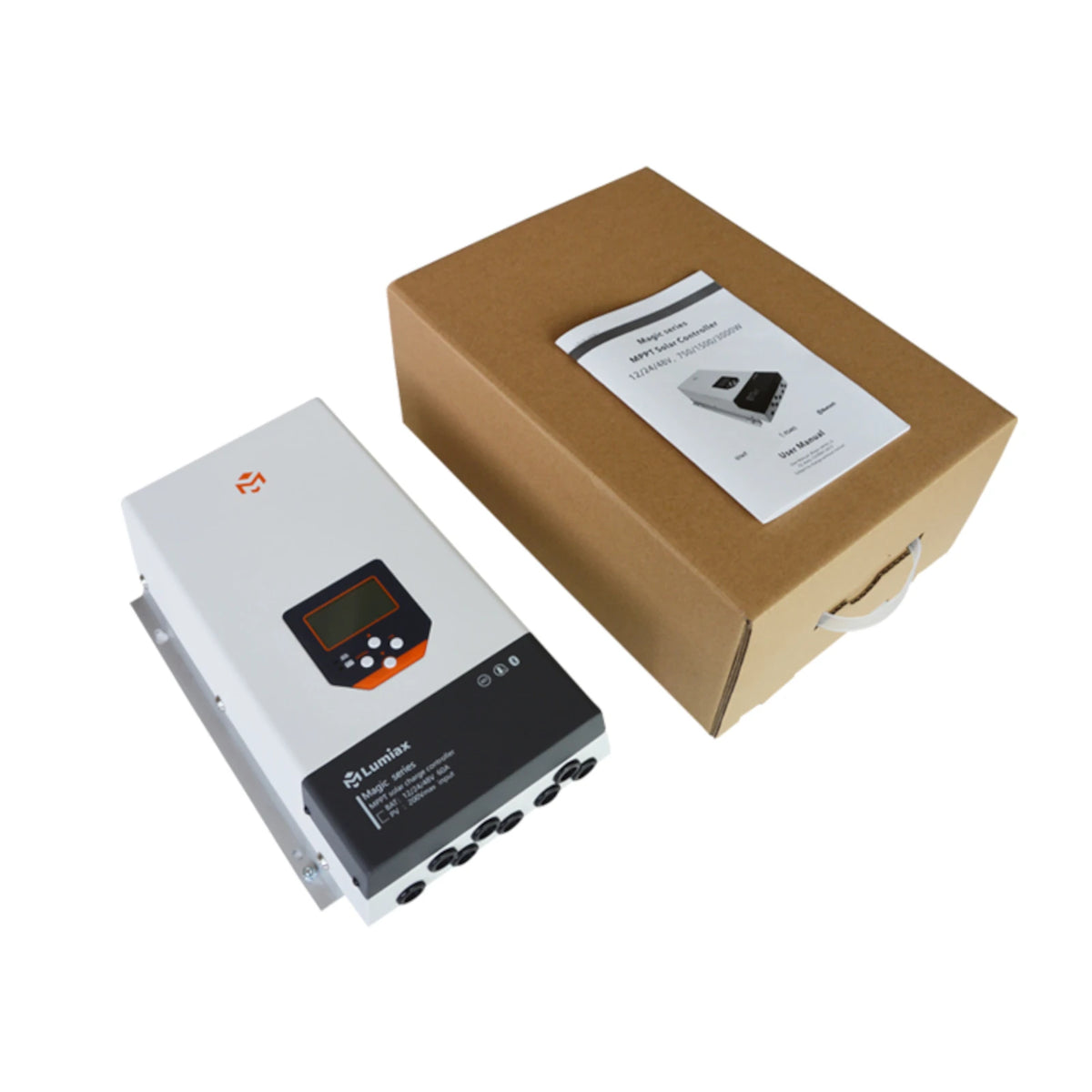
Sapphire Energy MT6020-PRO 60A MPPT Solar Charge Controller - Bluetooth + RS485
The MT6020-PRO is a high-capacity 60A MPPT solar charge controller for 12V, 24V, and 48V battery systems. Its high-voltage PV input supports longer series strings and lower array current, making it a practical choice for cabins, workshops, telecom sites, marine systems, large RVs, and other serious off-grid installations.
Built-in Bluetooth provides convenient wireless monitoring and configuration, while the RS485 Modbus interface supports wired system integration. A full-size LCD provides local setup, live operating data, fault information, and up to five years of charging history without requiring a phone.
Why You’ll Love It
- Heavy-duty 60A construction with a substantial heatsink and larger internal components for demanding solar systems
- 12V / 24V / 48V operation with automatic or manual system-voltage selection
- High-voltage PV input for flexible series-string design and reduced PV-side current
- Bluetooth and RS485 connectivity for convenient app access, wired Modbus integration, and the optional LCD01 remote display
- LiFePO4 compatible with adjustable lithium charging parameters and low-temperature charge control
- Large LCD and five-year data logging for local setup, performance history, and fault information

Mounting the controller in an electrical cabinet, storage compartment, or utility area? The compatible LCD01 remote display puts system status and controller settings in a convenient location using a simple wired RS485 connection.
Technical Specifications
| Model | MT6020-PRO |
| Rated Charge Current | 60A |
| Battery System Voltage | 12V / 24V / 48V |
| System Voltage Selection | Automatic or manual 12V / 24V / 48V |
| Battery Types | Gel, AGM, Flooded / Liquid, Lithium |
| Grounding | Common Negative |
| Maximum PV Open-Circuit Voltage | 190V DC, including cold-weather Voc |
| Rated Maximum PV Input Power | 750W at 12V 1500W at 24V 3000W at 48V |
| MPPT Tracking Range | Battery voltage + 2V to 90% of PV Voc |
| MPPT Tracking Efficiency | >99.9% |
| Maximum Charge Conversion Efficiency | Up to 98% |
| Self-Consumption | <5W |
| Display | Built-in LCD with operating data, settings, history, and fault display |
| Data Memory | Up to 5 years |
| Bluetooth | Built in |
| Wired Communication | RS485 Modbus via RJ11; non-isolated |
| Remote Display Compatibility | LCD01 remote LCD display via RS485 |
| IoT | Dedicated interface for optional IoT module; module not included |
| Control Outputs | Load-control relay and utility/generator-control relay 3A at 30V DC control-contact rating |
| Battery Voltage Sensor | Remote-sense terminal included; sensor wire not included |
| Temperature Sensor | Local temperature sensor included; optional remote sensor available |
| Cooling | Internal temperature-controlled fan |
| Protection Rating | IP20 |
| Power Terminal Capacity | Up to 35mm² / 2 AWG |
| Operating Temperature | -20°C to +60°C |
| Storage Temperature | -25°C to +80°C |
| Humidity | 5% to 95% RH, non-condensing |
| Maximum Altitude | 4000m |
| Dimensions | 339 × 230 × 109mm 13.35 × 9.06 × 4.29 in |
| Mounting Pattern | 220 × 215mm with 6mm mounting holes |
| Weight | 5kg 11.0lb |
Specifications are based on the manufacturer documentation for the MT6020-PRO Bluetooth and RS485 version. Grounding configuration for this supplied model is common negative.
Solar Array Sizing
| Battery System | Rated Maximum PV Input |
| 12V | 750W |
| 24V | 1500W |
| 48V | 3000W |
The controller limits charging to its rated current and power. The manufacturer permits a PV array up to 120% of rated input power when properly designed, but the applicable PV open-circuit-voltage limit must never be exceeded.
Built for Large Off-Grid Systems
The MT6020-PRO can use higher-voltage panel strings to reduce PV-side current and voltage drop, which is especially useful on larger arrays or longer wire runs. Its MPPT algorithm continuously adjusts the operating point of the array and limits charge output to protect the controller when available solar power exceeds its rated output.
Selectable profiles support flooded lead-acid, AGM, gel, and lithium batteries. Lithium mode provides adjustable charging target and recovery voltages, plus selectable low-temperature behaviour: normal charging, reduced-current charging, or charging disabled below 0°C.
Use an 80A battery fuse and cabling suitable for the circuit length, installation method, allowable voltage drop, and applicable electrical requirements.
Applications
- Cabins, workshops, sheds, and larger off-grid buildings
- Large RV, bus-conversion, and expedition-vehicle solar systems
- Marine and sailboat battery charging systems
- 12V, 24V, and 48V LiFePO4 battery banks
- Telecom, security, and remote monitoring sites
- Hybrid solar systems using external generator or utility charging
Installation Notes
Install the controller upright on a non-combustible surface in a dry, ventilated location. Leave at least 150mm (6 in) of clearance around the controller for airflow, keep the cable openings facing downward, and do not install it in direct sunlight, outdoors, or in a wet compartment.
Connect and energize the battery before connecting the solar array so the controller can establish the correct system voltage. Use suitable battery overcurrent protection, PV isolation, strain relief, and properly sized conductors. The chassis grounding point should be bonded in accordance with the system design and applicable electrical requirements.
The MT6020-PRO includes a utility/generator control relay that can request backup charging when battery voltage falls below the programmed threshold. Its 3A/30V DC contact is intended for a low-current generator-start input or a suitably rated external relay—not for carrying starter-motor current directly.
Frequently Asked
Can I use the MT6020-PRO with LiFePO4 batteries?
Yes. Lithium mode allows the charging target, charging-recovery voltage, low-voltage disconnect, and low-voltage reconnect settings to be adjusted for your battery. Always match the settings to the battery manufacturer's requirements and remember that the battery's BMS remains the final layer of protection.
Does this version include both Bluetooth and RS485?
Yes. This MT6020-PRO version has built-in Bluetooth for compatible mobile-app monitoring and setup, plus a wired RS485 Modbus interface. A 1m RJ11 RS485 cable is included.
Can I connect the LCD01 remote display?
Yes. The MT6020-PRO is compatible with the LCD01 remote display through its RS485 connection. This lets you mount the charge controller close to the batteries while placing the display somewhere easier to see and operate.
What is the PV voltage limit?
The maximum PV input is 190V open circuit. Solar-panel voltage rises as the panels get colder, so your string must remain below 190V on the coldest expected morning—not only when it is warm outside.
For example, imagine a panel string measuring 150V open circuit at 20°C. If the panels have a Voc temperature coefficient of -0.30% per °C, cooling them to -20°C represents a 40°C change and increases voltage by approximately 12%. That 150V string would rise to about 168V:
150V × 1.12 = 168V
That example remains comfortably below the 190V controller limit. Your actual result depends on the panel's published Voc and temperature coefficient, so use the values from its datasheet when choosing how many panels to connect in series.
How much solar can I connect?
Rated maximum PV input power is 750W on a 12V battery system, 1500W on 24V, and 3000W on 48V. The controller limits output to 60A. The manufacturer permits up to 120% over-paneling when the array is properly engineered, but PV open-circuit voltage must remain within the applicable limit under all conditions.
Can the relay outputs directly power a large DC load?
No. The relay connections are control outputs rated at 3A and 30V DC. Use them to control a suitably rated external relay, contactor, generator-start circuit, or other low-current control input. Do not connect a large inverter or other high-current load directly to these terminals.
Does the controller include a load output?
It does not have a conventional high-current load terminal. Instead, it provides a low-current load-control relay output that can operate an external relay or contactor. Loads should be powered from the battery through suitable distribution, wiring, fusing, and low-voltage protection.
What fuse should I use between the controller and battery?
The manufacturer specifies an 80A battery fuse for this 60A controller. The fuse protects the cable, so the final type and rating must also be suitable for the conductor, available fault current, installation method, and applicable code.
Do I need a PV disconnect?
A properly rated PV disconnect is strongly recommended and may be required by applicable electrical rules. It allows the solar array to be safely isolated before the controller or battery system is serviced. The disconnect and any PV overcurrent protection must be rated for the array's maximum DC voltage and current.