


Sapphire Energy
Dual Power Distribution Bus Bar Kit (M8 5/16")
Dual Power Distribution Bus Bar Kit (M8 5/16")
Couldn't load pickup availability
Dual High-Current Power Distribution Bus Bar Kit
Compact, professional power distribution for RVs, boats, vans, service vehicles, and off-grid electrical systems. Built with tinned copper bars, rated for up to 48VDC Systems. Choose between 275A and 400A versions to match the demands of your installation.
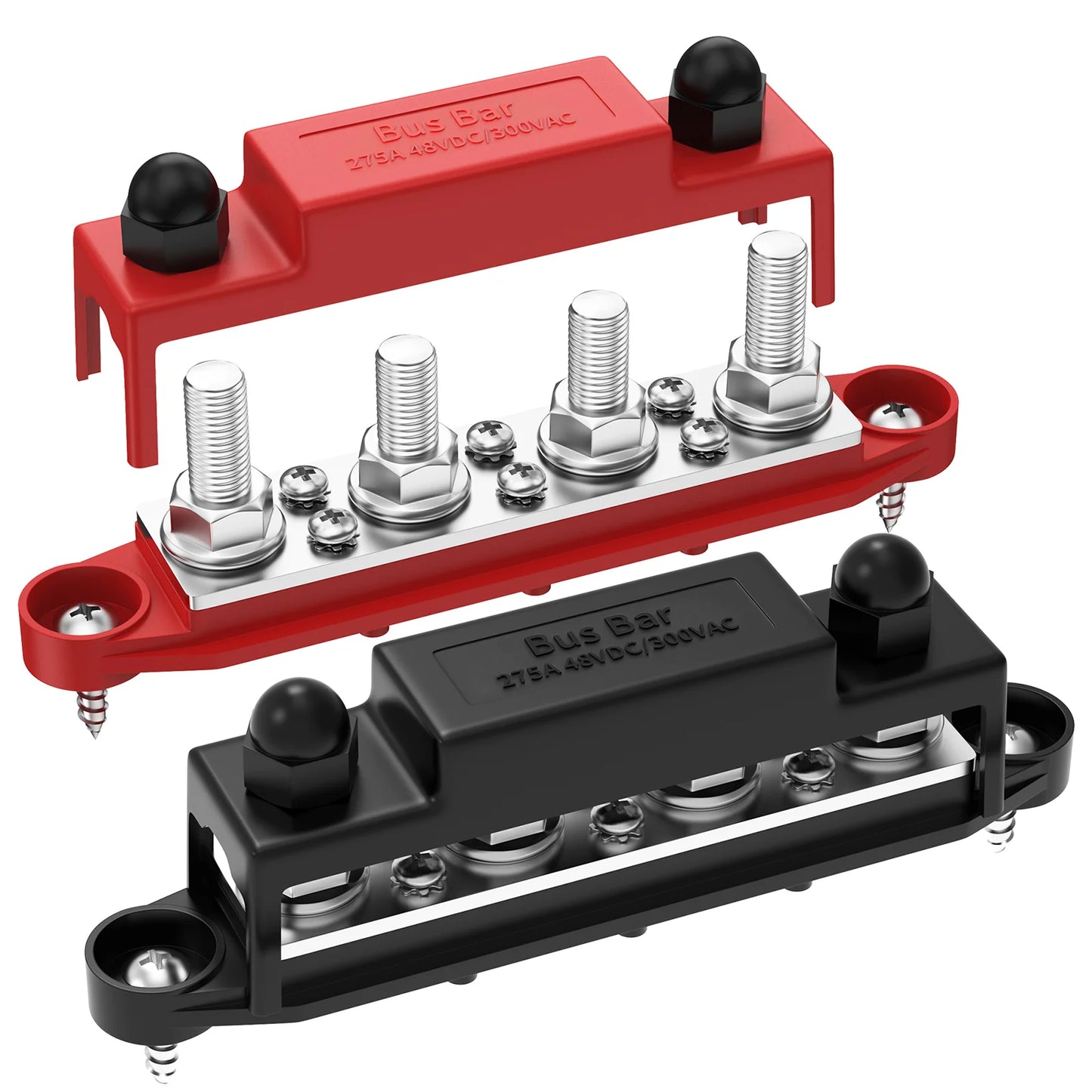
Each kit includes a red positive bus bar and a black negative bus bar, with 4 × M8 (5/16") main studs and 6 × M4 (#8) accessory screws on each bar. This mixed-terminal layout keeps high-current battery and inverter cables organized while providing convenient connection points for smaller charging, monitoring, and distribution circuits.
We intentionally choose M8 (5/16") studs because they're the industry standard on most lithium batteries, fuse holders, inverters, and other DC power equipment. This reduces the need for custom battery cables while still accepting standard cable lugs with either 5/16" or 3/8" mounting holes.
Better flexibility. Easier Install.
Why You’ll Love It
- Choose the capacity you need: Available in 275A and 400A continuous-current versions for everything from compact auxiliary systems to demanding inverter and charging installations.
- Tinned copper construction: Delivers excellent conductivity with added corrosion resistance for dependable use in RV, marine, automotive, and off-grid environments.
- M8 main studs: Matches the terminal size commonly used on lithium batteries and other DC equipment, while also accepting cable lugs with 3/8" mounting holes.
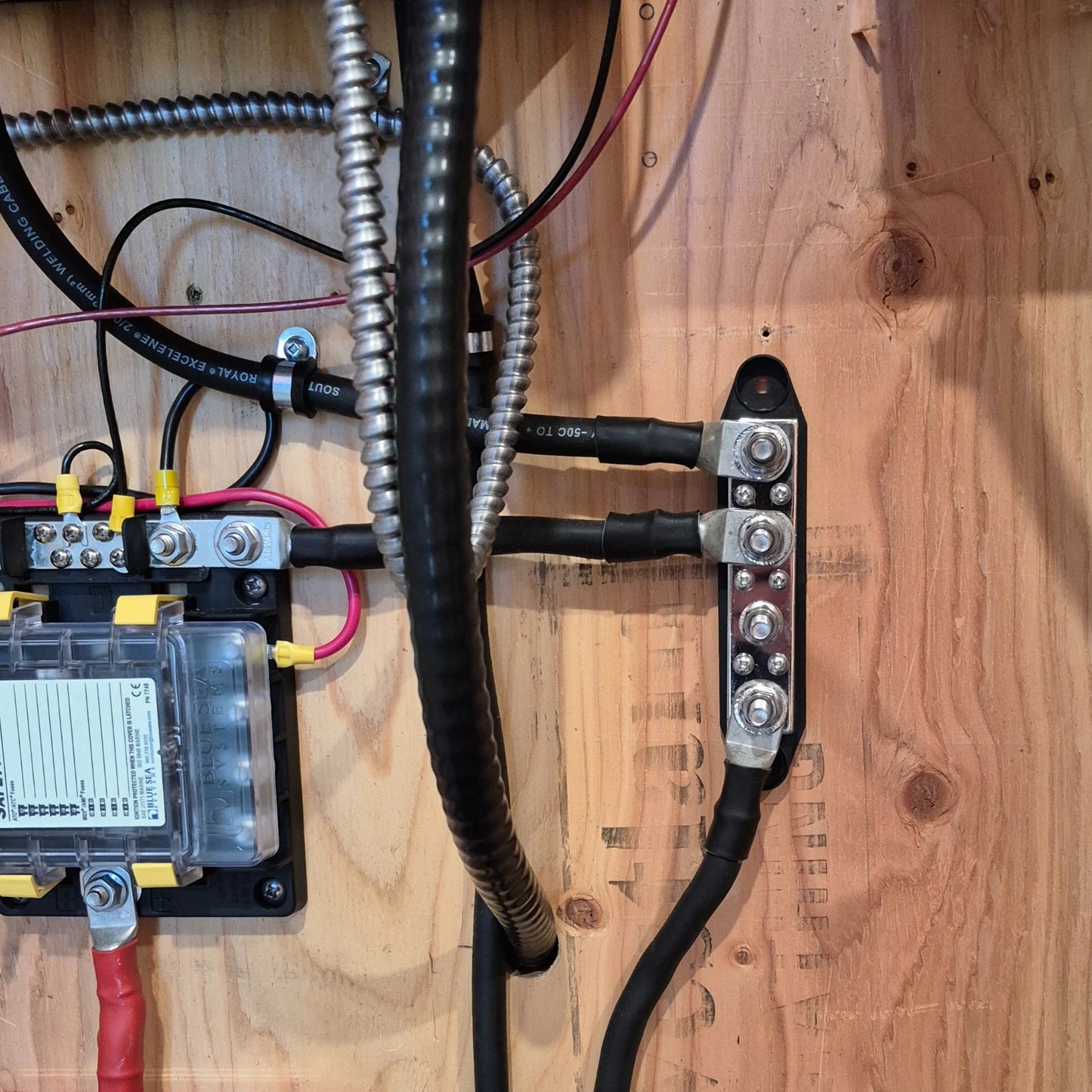
- Mixed wiring made easy: Four main studs handle large battery, inverter, charger, and distribution cables, while six accessory screws provide dedicated connection points for smaller circuits.
- Designed to maximize every terminal: The studs and accessory screws are spaced to allow compatible ring terminals to be installed on both at the same time.
- Complete positive and negative kit: Includes one red and one black bus bar, insulating covers, and mounting hardware for a clean, color-coded installation.
Great For
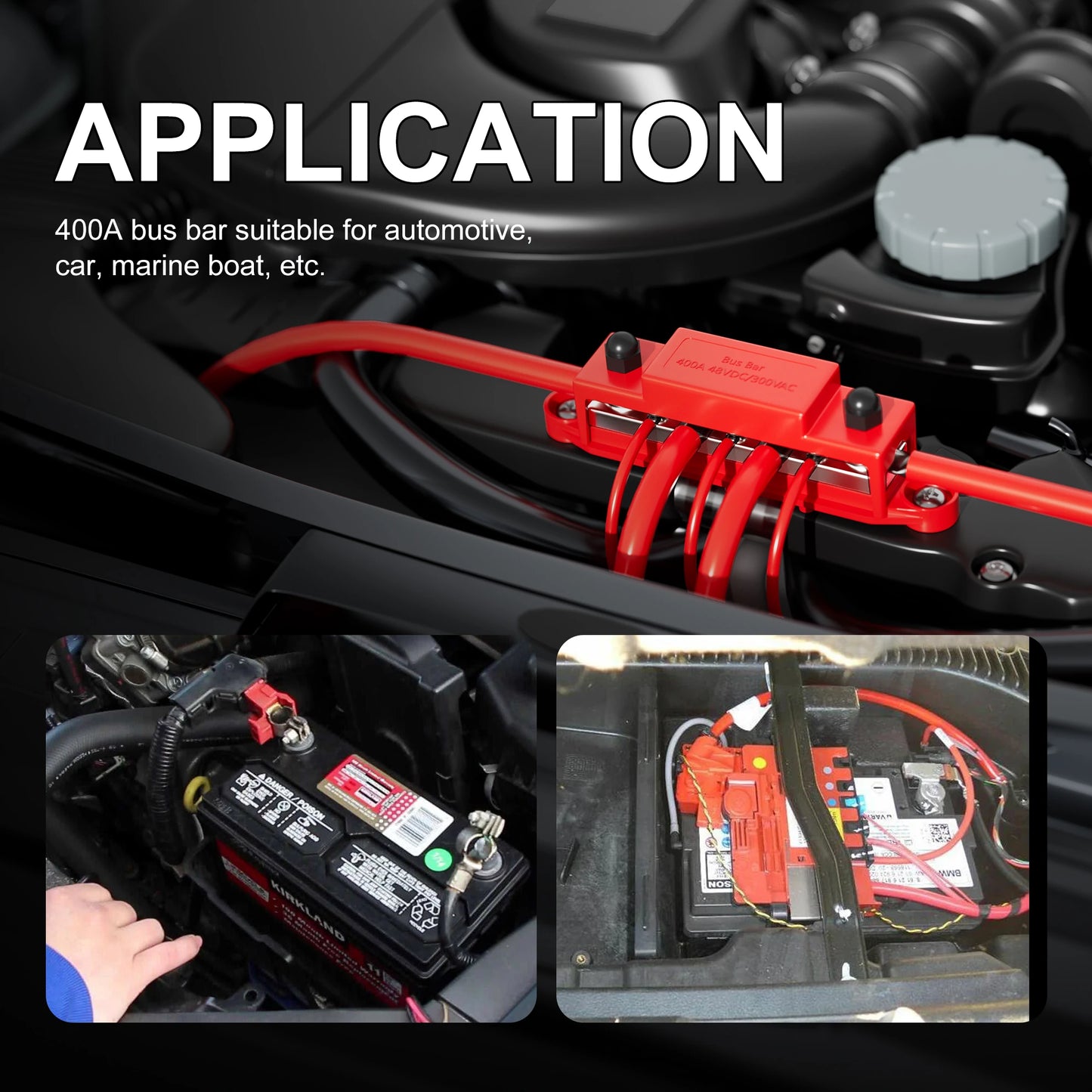
Battery banks, inverter systems, solar installations, DC distribution panels, marine and RV power centers, service vehicles, overland builds, and other 12V–48V systems requiring clean, high-current power distribution.
Specifications
| Continuous Rating | 275 Amp / 400 Amp |
|---|---|
| Max Voltage (Nominal) | 48V DC |
| Lugs / Screws | 4 × M8 studs (5/16") 6 × M4 (#8) screws |
| Copper Bus Thickness | 275A Version: 3.5 mm 400A Version: 8 mm |
| Busbar Material | Tinned copper |
| Hardware | Stainless steel |
| Base and Cover Material | Durable nylon |
| Dimensions (L × W × H) | 166 × 34 × 43 mm 6.54 × 1.34 × 1.69 in |
What’s Included
- 1 × Red positive bus bar with insulating cover
- 1 × Black negative bus bar with insulating cover
- Mounting screws and hardware
Installation Notes
- Select the bus bar rating, cable size, terminals, and circuit protection according to the maximum current expected in your system.
- Use properly crimped cable lugs and tighten all connections according to the applicable hardware and cable-terminal specifications.
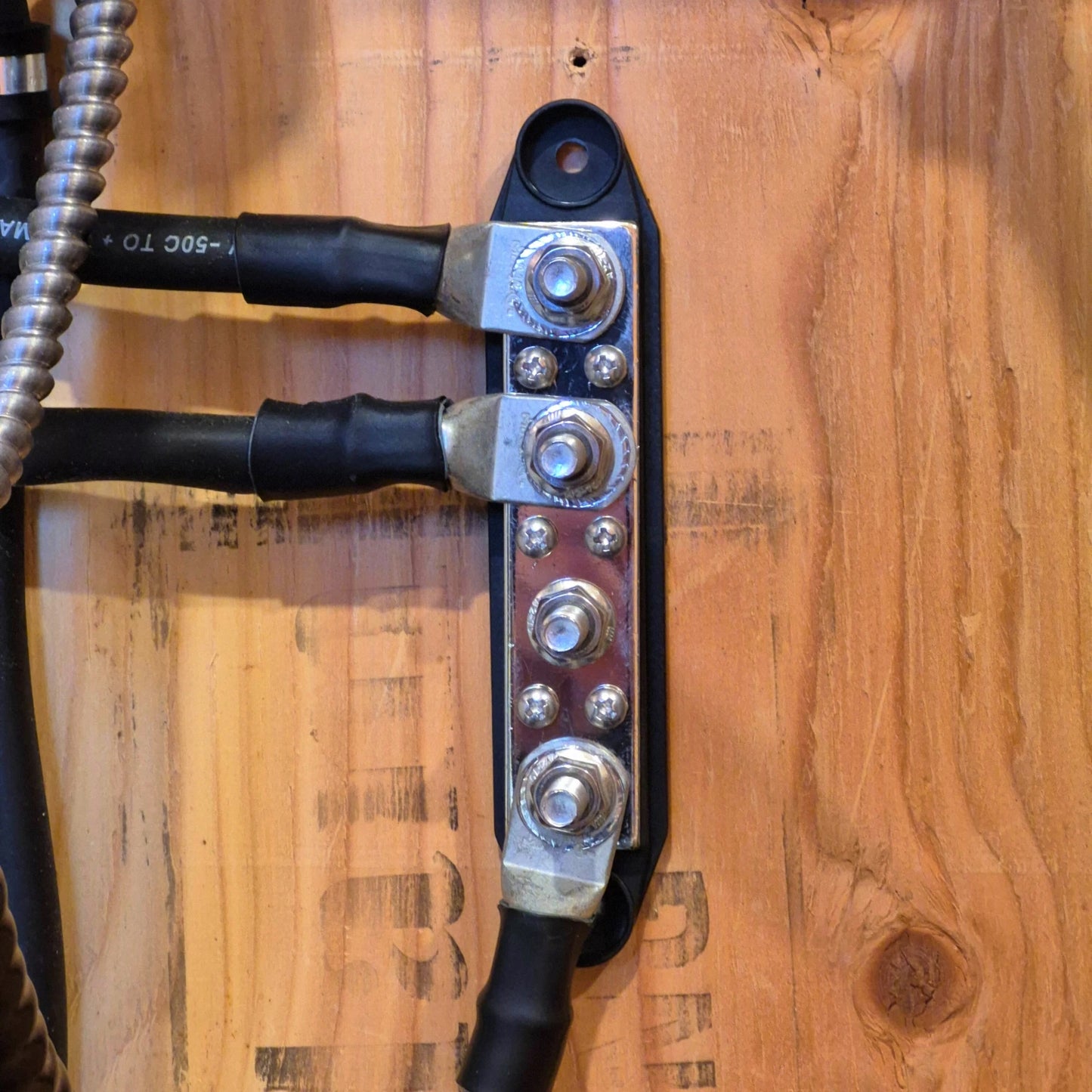
- Cable lugs with either 5/16" or 3/8" mounting holes may be used on the M8 studs when securely clamped with the supplied hardware.
- The accessory screws are intended for compatible small ring terminals. Confirm that each terminal seats flat and remains clear of adjacent hardware.
- Terminal fitment can vary between lug manufacturers. The layout has been tested with a range of Sapphire cable lugs to allow the main studs and accessory screws to be used together wherever terminal dimensions permit.
- Install the insulating covers and maintain suitable clearance from nearby conductive components.
Frequently Asked Questions
What is the difference between the 275A and 400A versions?
Both versions have the same overall layout, with four M8 main studs, six accessory screws, a durable nylon base, insulating covers, and tinned copper construction. The principal differences are the continuous-current rating and the thickness of the copper busbar.
The 275A version uses a 3.5 mm thick tinned copper busbar and is suitable for many RV, marine, automotive, and off-grid installations. The 400A version uses a substantially thicker 8 mm busbar for systems with larger inverters, higher charging currents, or heavier continuous loads.
Which current rating should I choose?
Choose a bus bar with a continuous-current rating above the highest current you expect it to carry during normal operation. Remember that the current passing through the bus bar may include several devices operating at the same time, such as an inverter, charger, DC fuse panel, and solar charge controller.
The 275A version is suitable for many moderate-power systems, while the 400A version provides additional capacity for larger inverter systems and high-output battery banks. Your cables, terminals, fuses, disconnects, and other components must also be appropriately rated—the bus bar rating does not increase the capacity of the rest of the circuit.
Will these bus bars work with lithium battery systems?
Yes. These bus bars are an excellent choice for LiFePO4 (lithium iron phosphate) battery systems and are equally suitable for lead-acid, AGM, and gel batteries. They're designed for use in 12V, 24V, and 48V nominal DC systems, making them ideal for RVs, marine applications, off-grid solar, service vehicles, and other battery-powered installations.
A common point of confusion is the 48V rating. In the battery industry, "48V" refers to the nominal system voltage, not the maximum charging voltage. A typical 48V LiFePO4 battery bank charges to approximately 58.4V, and these bus bars are fully suitable for use in those systems. This is standard practice across the industry, so you can confidently use them with modern lithium battery banks operating at their normal charging voltages.
As always, ensure the selected 275A or 400A current rating is appropriate for your installation, and properly size your cables, terminals, fuses, and disconnect devices to match the maximum current your system can safely carry.
Why do these bus bars use M8 (5/16") studs instead of 3/8" studs?
M8 studs provide an excellent balance of strength, compatibility, and usable terminal space. Lithium batteries and many common DC components already use M8 terminals, so keeping this connection size consistent reduces the need to purchase custom cables with different lug sizes at each end.
The studs provide ample clamping force for the rated applications and also accept cable lugs with 3/8" mounting holes. This gives installers the versatility to use either 5/16" or 3/8" lugs while preserving more usable space around each terminal and reducing interference with neighbouring connections.
What size cable lugs fit the main studs?
The main terminals are M8 studs, commonly described as 5/16". Cable lugs with a 5/16" mounting hole provide the closest fit, but standard lugs with a 3/8" mounting hole can also be securely installed using the supplied washer and nut.
This compatibility makes it easier to use commonly available battery cables without purchasing adapters or specialty cables. Always make sure the lug sits flat against the conductive surface and is securely clamped before placing the system into service.
What are the six smaller screw terminals used for?
The six M4 (#8) screws provide convenient connection points for smaller circuits that do not require one of the large main studs. Typical uses include monitoring equipment, solar charge controllers, DC fuse panels, low-current chargers, relays, and other accessory circuits.
The screw terminals and main studs are deliberately spaced so compatible ring terminals can be installed on both at the same time. Lug dimensions vary between manufacturers, but we have tested the layout with a variety of Sapphire terminals to help customers maximize the usable connection capacity of each bar.
Does this kit include both the positive and negative bus bars?
Yes. Each kit includes one red bus bar for positive distribution and one black bus bar for negative distribution. Both bars include insulating covers, along with the required mounting hardware.
The two bus bars are electrically independent. They can be mounted together as a matched positive-and-negative distribution point or positioned separately to suit the layout of your electrical system.
Are these bus bars suitable for marine installations?
Yes. The conductive bars are made from tinned copper, combining excellent electrical conductivity with improved resistance to oxidation and corrosion. This makes them well suited to properly installed marine, RV, automotive, and off-grid electrical systems.
The insulating covers and durable nylon bases also help create a clean and protected installation. As with other marine electrical equipment, the bus bars should be installed in a suitable location and protected from direct spray, standing water, and physical damage.
Do I need to use fuses with a bus bar?
Yes. A bus bar distributes power but does not provide circuit protection. Each wire must be protected according to its safe current-carrying capacity and the requirements of the connected equipment.
A simple rule for beginners is that whenever a circuit steps down to a smaller wire than the cable feeding the bus bar—or to a wire smaller than the upstream fuse can safely protect—the smaller outgoing wire should have its own appropriately sized fuse or circuit breaker. For this reason, it is generally recommended to fuse the wires leaving the bus bar as close to the distribution point as practical.
Browse our fuses and circuit-protection products for options suitable for small accessory circuits through high-current battery and inverter cabling.
Can I connect multiple bus bars together?
Yes. Multiple bus bars can be linked to add more connection points or create separate distribution areas for equipment such as inverters, chargers, solar controllers, and DC fuse panels.
Use a short, appropriately sized high-current cable between the bus bars. The interconnect must be capable of carrying the maximum current that may flow between them, and the complete system must be arranged so its cables and circuit protection remain within their safe ratings. Keeping the link short helps reduce resistance and voltage drop.
We carry an assortment of high-current cables intended for battery-system and bus-bar interconnections. Feel free to contact us and we can help recommend or supply a suitable cable for your installation.
Share




Great quality and price.Fast shipping.Excellent from Russ.Extremly professional and conscious.
Best service I've ever experienced
I'm a customer for life.