Victron Energy
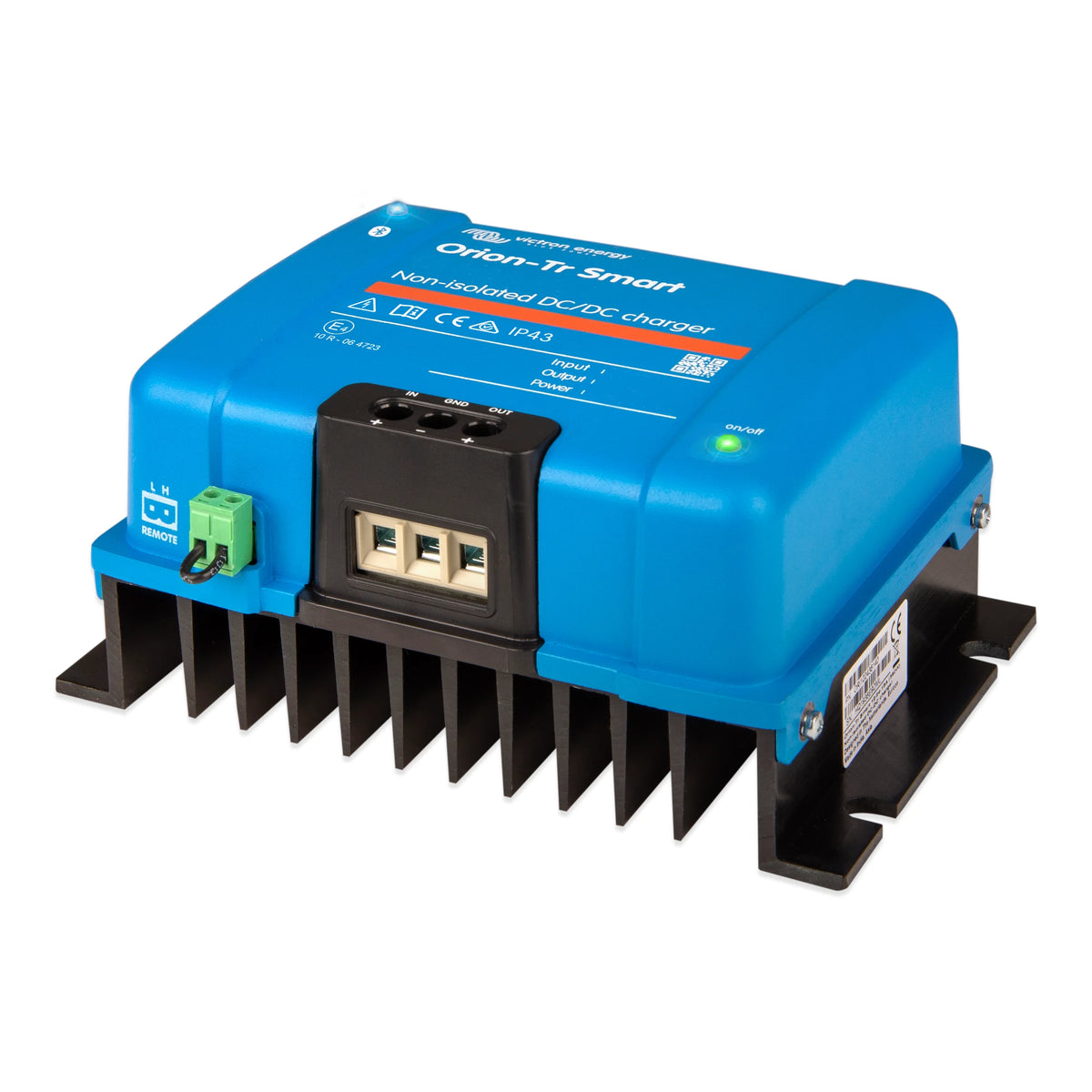
Victron Orion-Tr Smart 12/12-30A Non-Isolated DC-DC Charger
Victron Orion-Tr Smart 12/12-30A Non-Isolated DC-DC Charger
Couldn't load pickup availability
Victron Orion-Tr Smart 12/12-30A Non-Isolated DC-DC Charger
Reliable Alternator Charging for Dual Battery Systems
The Victron Orion-Tr Smart 12/12-30A Non-Isolated DC-DC Charger provides controlled charging from a 12V starter battery and alternator to a 12V auxiliary battery bank. It is an excellent solution for camper vans, RVs, overland vehicles, service trucks, emergency vehicles and mobile workstations.
Unlike a basic DC voltage converter, the Orion-Tr Smart uses an adaptive multi-stage charging profile to properly charge compatible lithium and lead-acid batteries. Built-in Bluetooth provides convenient configuration, status information and system setup through the free VictronConnect app.
Why You'll Love It
- Up to 30A of controlled auxiliary-battery charging
- Built-in Bluetooth configuration through VictronConnect
- Compatible with LiFePO₄ and lead-acid batteries
- Adaptive bulk, absorption and float charging
- Built-in engine shutdown detection
- Compatible with conventional and many smart alternators
- Common-negative design for straightforward vehicle installations
Built-in engine shutdown detection allows the charger to operate while the engine is running and stop charging when the alternator is no longer supplying power. Its settings can be adjusted through VictronConnect to suit the voltage behaviour of the vehicle and alternator.
Built-In Bluetooth Configuration
Connect directly to the Orion-Tr Smart using the free VictronConnect app on a compatible phone or tablet. Bluetooth makes initial setup and future adjustments easier without requiring a separate display or programming cable.
- Select the correct charging profile for your battery
- Adjust absorption, float and storage voltages
- Configure engine shutdown detection thresholds
- Adjust input-voltage lockout settings
- View charger status and operating information
- Install supported firmware updates
The Orion-Tr Smart does not measure or display input or output current through VictronConnect. A separate battery monitor, such as a SmartShunt or BMV battery monitor, is required when detailed current and energy monitoring is desired.
Common-Negative, Non-Isolated Design
This non-isolated model uses a common negative connection between the starter-battery and auxiliary-battery circuits. It is a practical choice for many conventional vehicle and RV installations where both battery systems are intended to share the same chassis ground or negative bus.
The shared negative connection can simplify installation and requires one fewer main power conductor than the isolated version. Before choosing this model, confirm that the starter and auxiliary electrical systems are permitted to share a common negative connection.
Choose the non-isolated version when the starter and auxiliary systems are designed to share a common negative or chassis ground. Choose the isolated model when the two negative circuits must remain electrically separated, or when isolation is required to prevent unwanted ground paths.
Not sure which model is appropriate? Contact us with a description of your vehicle, battery bank and grounding arrangement.
Adaptive Battery Charging
In charger mode, the Orion-Tr Smart uses an adaptive three-stage charging process consisting of bulk, absorption and float stages. Charging voltages and timing can be configured through VictronConnect to suit the connected battery.
The charger can be configured for properly matched LiFePO₄, AGM, gel and flooded lead-acid batteries. Always use the charging settings recommended by the battery manufacturer.
This charger does not independently measure the auxiliary battery's cell temperature. When charging LiFePO₄ batteries in cold conditions, the battery must provide suitable low-temperature charging protection through its BMS, heater system or an appropriate external control.
Engine Shutdown Detection
The charger can detect whether the engine and alternator are operating by monitoring the input voltage. This allows it to begin charging after the engine starts and stop charging before the starter battery is excessively discharged.
The factory settings are suitable for many conventional alternators, but vehicles equipped with smart alternators may require adjusted start, shutdown and input-voltage thresholds. An ignition-controlled signal or other external control can also be connected when automatic voltage detection is not appropriate for the vehicle.
Parallel Operation
Multiple Orion-Tr Smart chargers can be connected in parallel when more charging current is required. Each charger must have appropriately sized wiring and overcurrent protection, and the vehicle's alternator must be capable of supporting the combined electrical load.
Two 30A chargers can provide up to approximately 60A of combined charging current, subject to temperature, wiring losses, alternator capacity and the charging limits of the auxiliary battery.
The charger operates alongside the vehicle's existing electrical equipment. Confirm that the alternator has enough available capacity to support the charger without being continuously overloaded, particularly during extended idling or operation in hot conditions.
The Orion-Tr Smart 12/12-30 does not provide the continuously adjustable output-current control found on newer Orion XS chargers. If the vehicle cannot safely support approximately 30A of auxiliary charging, choose a smaller charger or an adjustable-current model.
Cable and Fuse Protection
A 30A DC-DC charger can draw more than 30A from the starter-battery side because of conversion losses and differences between input and output voltage. Correct cable sizing is essential to minimize voltage drop and prevent the engine-detection system from shutting down prematurely.
The Orion-Tr Smart accepts conductors up to 16mm² (6 AWG). The appropriate cable and fuse sizes depend on cable length, conductor type, installation method and applicable electrical requirements.
Install appropriately sized DC overcurrent protection close to the positive connection of both the starter battery and auxiliary battery. Each fuse must be selected to protect the connected cable, not simply matched to the charger's 30A output rating.
Installation and Cooling
Install the charger vertically on a non-combustible surface with the power terminals facing downward. Provide sufficient open space around the enclosure so heat can escape naturally.
The Orion-Tr Smart can provide its full rated output at ambient temperatures up to 40°C. Above 40°C, available output is reduced as the charger protects itself from excessive temperature. Avoid installing it inside a sealed compartment or directly beside other major heat-producing equipment.
Applications
- Camper vans and van conversions
- RVs and motorhomes
- Overland and expedition vehicles
- Service trucks and work vehicles
- Emergency and response vehicles
- Mobile workshops and trailers
- Starter-to-house battery charging
- Common-negative dual-battery systems
- 12V LiFePO₄ auxiliary battery banks
Product Specifications
| Specification | Value |
|---|---|
| Model | Orion-Tr Smart 12/12-30A Non-Isolated |
| Victron Part Number | ORI121236140 |
| Input Voltage Range | 8–17V DC |
| Undervoltage Shutdown | 7V |
| Undervoltage Restart | 7.5V |
| Nominal Output Voltage | 12.2V |
| Output Voltage Adjustment Range | 10–15V |
| Continuous Output Current | 30A at 40°C |
| Maximum Output Current | 40A for up to 10 seconds |
| Short-Circuit Output Current | 60A |
| Continuous Output Power | 430W at 25°C / 360W at 40°C |
| Maximum Efficiency | 87% |
| No-Load Input Current | Less than 80mA |
| Standby Current | Less than 1mA |
| Charging Algorithm | Adaptive 3-stage: bulk, absorption and float |
| Battery Compatibility | LiFePO₄, AGM, gel and flooded lead-acid |
| Bluetooth | Built-in VictronConnect support |
| Engine Shutdown Detection | Built in and configurable |
| Remote ON/OFF | Yes |
| Parallel Operation | Multiple units permitted |
| Galvanic Isolation | No—input and output share a common negative connection |
| DC Connections | Screw terminals |
| Maximum Cable Size | 16mm² (6 AWG) |
| Operating Temperature | -20°C to +55°C |
| Output Derating | 3% per °C above 40°C |
| Humidity | Maximum 95%, non-condensing |
| Protection Rating | IP43 with terminals facing downward |
| Dimensions (L × W × H) | 186 × 70 × 130mm (7.32 × 2.76 × 5.12in) |
| Weight | 1.8kg (3.97lb) |
| Warranty | 5 Year |
| Standards | EN 60950, EN 61000-6-3, EN 55014-1, EN 61000-6-2, EN 61000-6-1, EN 55014-2 and ECE R10-5 |
Specifications are based on the manufacturer's published data and are believed to be accurate at the time of publication. Product specifications, certifications and dimensions may change without notice. Always verify compatibility with your specific equipment and refer to the official Victron documentation before installation. If you have any questions, contact us and we'll be happy to help.
Frequently Asked Questions
Does this work with LiFePO₄ batteries?
Yes. The charging voltages and timing can be configured through VictronConnect for a compatible 12V LiFePO₄ battery.
Use the settings recommended by the battery manufacturer and ensure the battery's BMS provides suitable protection against charging below its permitted temperature.
What does non-isolated mean?
A non-isolated charger internally shares the negative connection between the starter-battery and auxiliary-battery sides. Both battery systems therefore use a common negative connection or chassis ground.
This is suitable for many conventional vehicle and RV installations. Choose an isolated charger if the two negative circuits must remain electrically separated.
Should I choose the isolated or non-isolated version?
Choose this non-isolated version when the starter and auxiliary batteries are intended to share a common negative connection or chassis ground. It is typically the simpler choice for conventional dual-battery vehicle installations.
Choose the isolated version for systems requiring separate grounding arrangements or electrical separation between the input and output circuits.
Do I need an ignition wire?
Not necessarily. The built-in engine shutdown detection can determine whether the engine is operating by monitoring input voltage, so a separate ignition trigger is not required in many installations.
Some smart alternators or unusual vehicle electrical systems may require adjusted detection settings or an ignition-controlled signal for reliable operation.
Does it work with smart alternators?
It can work with many smart alternators, but the engine shutdown detection and input-voltage settings may need to be adjusted through VictronConnect. Smart-alternator voltage can change considerably during normal driving, so the factory settings may not be suitable for every vehicle.
An ignition-controlled signal may be used when voltage-based detection cannot reliably determine whether the engine is running.
Can I adjust the charging current?
The Orion-Tr Smart 12/12-30 does not provide the same continuously adjustable output-current setting found on newer Orion XS chargers. Its charging voltage and engine-detection settings are programmable, but it is fundamentally a 30A charger.
A smaller or adjustable-current charger may be more appropriate when the alternator, wiring or auxiliary battery cannot safely support approximately 30A of charging.
Can I connect multiple chargers in parallel?
Yes. Multiple Orion-Tr Smart chargers can be installed in parallel to increase the total available charging current.
Each charger requires suitable wiring and fuse protection. The alternator and auxiliary battery must also be capable of safely supporting the combined current.
What size cable should I use?
The charger accepts conductors up to 16mm² (6 AWG). The correct conductor size depends on the length of both the input and output circuits, allowable voltage drop, installation method and conductor temperature rating.
Cable sizing is particularly important on the starter-battery side because the charger can draw more than 30A at full output.
What size fuse should I use?
Fuse size must be selected according to the cable size and expected input or output current. Overcurrent protection should normally be installed close to the positive terminals of both the starter battery and auxiliary battery.
Because cable lengths and conductor sizes vary considerably between installations, final fuse selection should be based on the actual wiring rather than the charger's 30A output rating alone.
How does the remote ON/OFF port work?
The remote ON/OFF port provides several ways to control when charging is allowed. The supplied jumper can be left installed for automatic operation, or the port can be wired to an external switch, ignition-controlled signal or compatible battery-management control.
With automatic engine shutdown detection enabled, the charger monitors alternator voltage and starts or stops charging according to adjustable thresholds in VictronConnect. This allows it to work with conventional alternators as well as many smart alternators whose output voltage changes while driving.
The remote port controls whether charging is permitted; it does not carry the charger's main charging current.
Can I monitor charging current through Bluetooth?
No. VictronConnect can be used to configure the charger and view its operating status, but this model does not measure or display input or output current.
Install a compatible battery monitor, such as a Victron SmartShunt or BMV battery monitor, when accurate auxiliary-battery current and energy monitoring is required.
Can it be used as a power supply?
Yes. The Orion-Tr Smart can be configured through VictronConnect to operate as either a battery charger or a regulated DC power supply.
In power-supply mode, the output voltage is adjustable between 10V and 15V. Battery-charging mode should be used when charging an auxiliary battery.
Can I install it inside a sealed compartment?
No. The charger produces substantial heat while operating and requires open airflow around its enclosure. It should be mounted vertically with the terminals facing downward on a suitable non-combustible surface.
Output begins to derate above 40°C, so a hot or poorly ventilated compartment can significantly reduce available charging power.
What warranty does it include?
It is backed by Victron Energy's excellent 5-year warranty. This long warranty is one of the reasons Victron equipment is a strong choice for vehicle, marine and off-grid electrical systems.
Should you need troubleshooting or warranty assistance, Sapphire Energy can help review the installation and guide you through the support process.
Looking for a Victron product that isn't listed?
We can special order Victron products that are not currently listed on our website. Contact us with the product name or Victron part number, and we'll confirm pricing, availability and estimated delivery time.
Tell us about your vehicle, alternator and auxiliary battery. We can help confirm whether this charger is a suitable match and assist with cable sizing, fuse protection and installation planning before you order.
Share